Trombone
IN THIS LESSON
The Trombone is a Tenor brass instrument pitched one octave below the trumpet
Unlike most other brass instruments it uses a large slide rather than valves to change the pitch between harmonics.
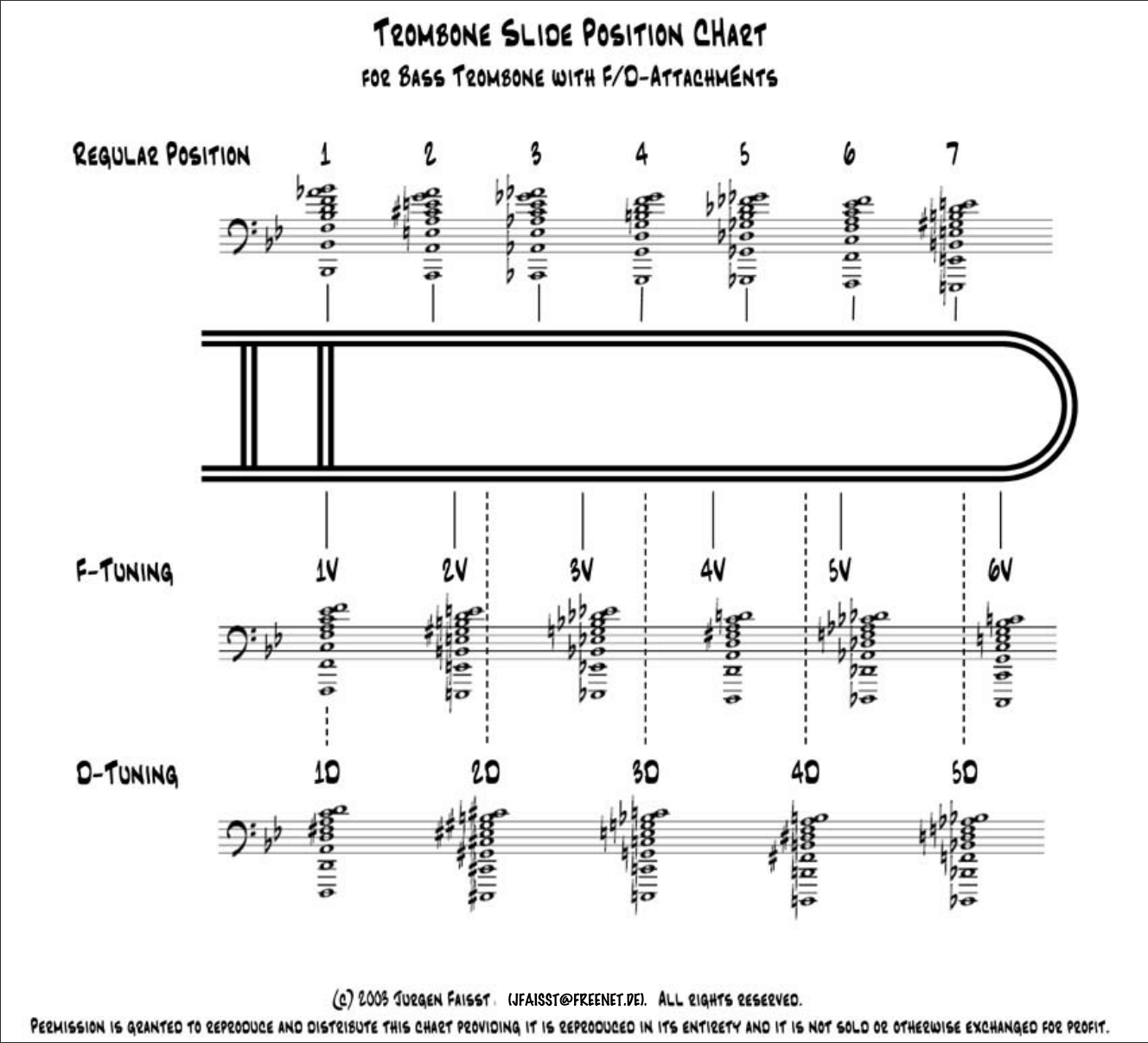
-
The Trombone uses a set of ‘slide positions’ in order to pitch different notes, these slide positions are labelled as 1, 2, 3 etc. A standard trombone has 7 positions.
Below the section labelled “Regular Position” there are two further categories, F tuning and D tuning. These correspond to the valve/triggers available on professional Tenor (F only) and Bass Trombones (F and D). As the instrument gets longer when the valve is engaged, the amount the slide moves for each position is extended to compensate meaning the trombone only has 5 or 6 positions based on the valves that are engaged.
-
To know if a gliss is possible, find the lowest number position the upper note is possible in. Then minus the number from 7 (for Bb tuning) and that is how many semitones lower you can have the gliss come from.
For Example, Ab3 on a standard trombone can only be played in 3rd position. 7-3=4, therefore I can go 4 semitones lower and gliss between Ab and E.
-
Standard Range E2-G4
Extended Register (Professionals) C2-F5